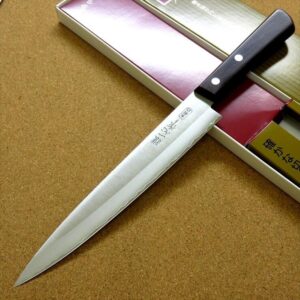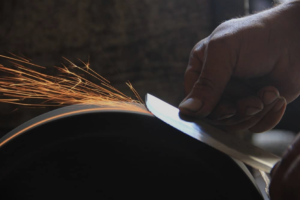

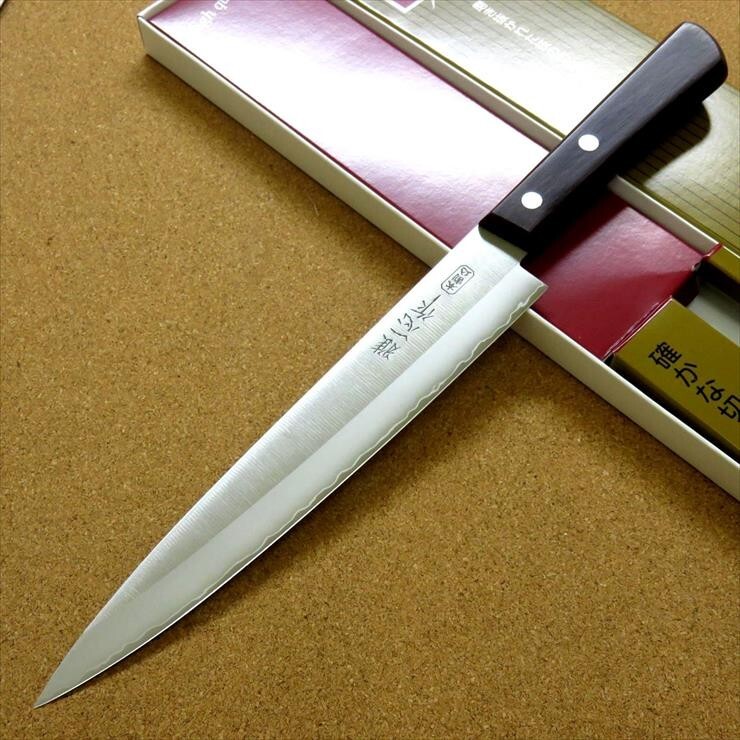
Japanese knife sharpening is both an art and a science. Unlike Western-style blades, Japanese kitchen knives are ground at a much steeper, more precise angle, which is what gives them their signature razor-thin, hair-splitting edge. If you own a Gyuto, Santoku, or Nakiri, learning how to keep that edge alive is one of the best things you can do for your kitchen. In this guide, we’ll walk through the techniques, tools, and steps that go into caring for these blades properly, and when it makes more sense to leave the job to a professional.
Western knives are typically sharpened to an angle of around 20 to 22 degrees per side, built for durability over sheer sharpness. Japanese blades, on the other hand, are usually sharpened between 12 and 16 degrees per side, sometimes even sharper for single-bevel knives like a Yanagiba. This narrower angle is exactly what makes Japanese knife sharpening such a different discipline from standard Western methods. The steel used in most Japanese blades is also harder, which means it holds an edge much longer but is more prone to chipping if sharpened incorrectly, stored badly, or used on the wrong cutting surface. Understanding this difference is the first step before you pick up a stone.
The gold standard here is a wet whetstone, not a pull-through electric sharpener. A whetstone lets you control the exact angle and pressure, which matters enormously on a blade this thin. Most sharpeners work through a progression of grits: a coarse stone (around 400–600 grit) to repair chips or reshape a dull edge, a medium stone (1000–2000 grit) for everyday maintenance, and a fine finishing stone (4000–8000 grit) to polish the edge to a mirror finish. You can read more about how sharpening stones work and how grit progression affects edge quality if you want to go deeper into the science of it. Some sharpeners also finish single-bevel Japanese blades with a leather strop to remove any final burr, a step that’s far less common on Western double-bevel knives.
If you’re wondering how to sharpen Japanese knives at home without damaging them, follow this simple routine:
1. Soak your whetstone in water for 10–15 minutes until air bubbles stop rising.
2. Hold the blade at a consistent 12–16 degree angle against the stone.
3. Use light, even strokes, always pushing away from the edge, moving from heel to tip.
4. Repeat the same number of strokes on both sides to keep the edge centered.
5. Move through your grit progression, finishing on the highest grit stone you own.
6. Strop the blade on leather or a cloth to remove any leftover burr.
This process for Japanese kitchen knife sharpening takes practice, and it’s easy to round off an edge or apply uneven pressure the first few times. A cheap or incorrectly graded stone can do more harm than good, so if you’re just getting started, it’s worth browsing our shop for stones and accessories that are actually suited to Japanese steel, rather than a generic all-purpose kit.
Not everyone has the time, tools, or patience to master whetstone work, and that’s completely fine. If your knife has a chip, an uneven bevel, or you simply don’t want to risk your favorite Gyuto on a learning curve, a professional service is the safer route. At Knife Tech, our Japanese knife sharpening service uses the same graduated whetstone process described above, carried out entirely by hand, so your blade keeps its original geometry instead of being reshaped by a machine grinder. Turnaround is usually the same day, and every knife is inspected for chips or damage before sharpening begins. You can also read more about our background and approach to blade care on our Story page, or get in touch directly if you’d like to book a drop-off or mobile appointment.
Most home cooks only need a full sharpening once or twice a year if the knife is honed regularly and stored on a magnetic strip or in a saya, rather than tossed loosely into a drawer. Professional kitchens that use their knives daily will usually want a touch-up every few weeks, since the harder Japanese steel chips more easily on cutting boards, bones, or ceramic surfaces than softer Western steel does. Keeping a consistent schedule is far easier on the blade than waiting until it’s completely blunt.
Mastering Japanese knife sharpening at home is absolutely possible with the right stones, a steady hand, and some patience but it’s a skill that takes real practice to get right, and a rushed attempt can do more harm than a few months of gentle dulling ever would. Whether you decide to sharpen your own blades or hand them over to a specialist, the goal is the same: preserving that thin, precise edge that makes Japanese knives such a pleasure to cook with. If you’d rather skip the learning curve altogether, our team is always ready to help restore your knives to their original sharpness.